Mirrors & Molecules
If you have been introduced to organic chemistry, you know that arranging atoms in different order allows you to get different functional groups, each with different properties. Placement of atoms in 3D space also needs to be taken into account. An important idea is chirality, where a molecule has a mirror image that is non-superimposable. While this sounds very complex, you can see an example with your hands. You can can “reflect” your hand by placing your palms together but if you stack your hands on top of one another your thumbs will face opposite directions. Your hands are chiral! Chirality of molecules will impact their properties when placed in a chiral environment, like biological systems. Your body in fact contains many chiral molecules from amino acids in proteins to the building blocks of your DNA (nucleic acids).
In this workshop you will learn to identify chiral objects and molecules, find the relations between them (mirror images or not) and get comfortable building 3D models like a professional chemist would!
Leanne Racicot
Leanne Racicot is an organic chemistry laboratory instructor at the University of Waterloo. They obtained their PhD in Chemistry at the University of British Columbia in 2016 for their work on hypervalent iodine molecules. She held a joint post-doctoral Thode fellowship between the University of Waterloo and McMaster University to use hypervalent iodine reagents for 18F-labelling of small molecules.
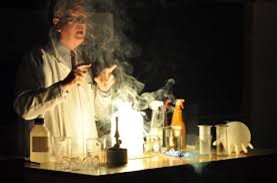
They started teaching in 2019, spending most of their time offering introductory organic chemistry laboratories for non-Chemistry majors (Biology, Biomedical Sciences and Engineering programs). Leanne also periodically lectures organic chemistry or first-year chemistry and supervise the delivery of the on-campus high school outreach program and is the resident ‘chemistry magic’ demonstrator.